Since 1912, when the predecessor of Beijing Jiaotong University (BJTU) — the Beijing Railway Management Training Institute — established the "Advanced Electrical Engineering Class A", the Electrical Engineering discipline at BJTU has a history of over a century. After the founding of the People's Republic of China, in response to the needs of national economic construction, Beijing Railway Institute set up the Department of Electrification Engineering in 1958. In 2000, the former Beijing Higher Vocational College of Electric Power was merged into BJTU, and the university came under the direct administration of the Ministry of Education. Relevant disciplines and specialties of electrical engineering were reorganized to form the School of Electrical Engineering of Beijing Jiaotong University.
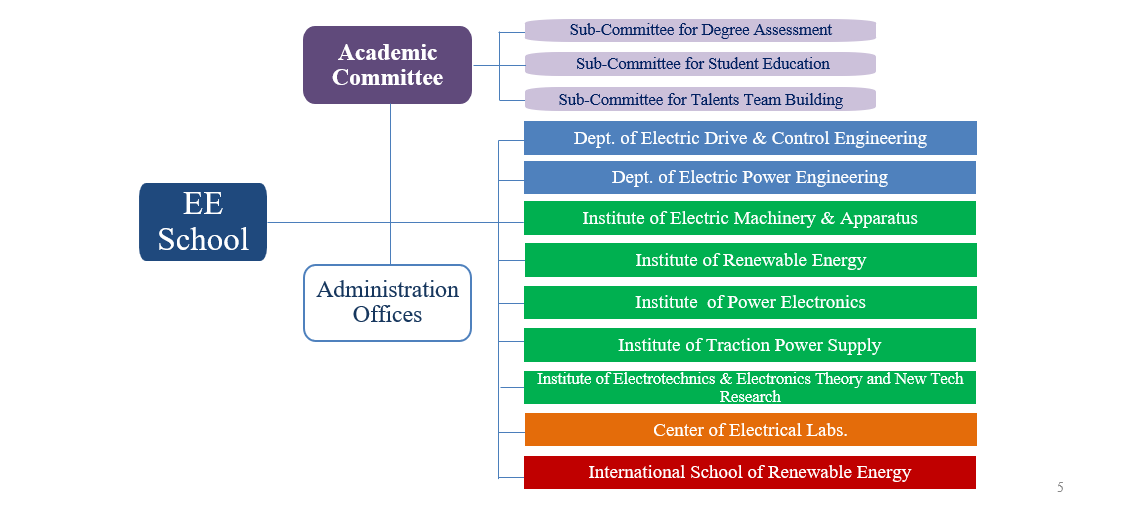
The School of Electrical Engineering is located in the Electrical Engineering Building in the southeast of BJTU's main campus. Currently, the school has the following teaching and research units:
Department of Electrical Drive and Control Engineering
Department of Power Engineering
Institute of Electrical Machines and Apparatuses
Institute of New Energy
Institute of Power Electronics
Institute of Traction Power Supply
Institute of Electrical Theory and New Technology
Electrical Comprehensive Experiment Center
The school has 178 faculty and staff members, including 111 full-time teachers. Among the full-time teachers, there are 43 professors and 59 associate professors. It has 68 doctoral supervisors and 115 master's supervisors, and 93% of the full-time teachers hold doctoral degrees. The school's talent pool includes: 1 national candidate for the "Millions of Talents Project", 1 recipient of the National Natural Science Foundation of China (NSFC) Excellent Young Scientists Fund, 1 IEEE Fellow, 2 IET Fellows, 3 Beijing Science and Technology Stars, 1 Beijing Outstanding Teacher, 1 Beijing Outstanding Young Teacher, 4 experts enjoying special government allowances from the State Council.
The school has over 2,400 students, including more than 1,300 full-time undergraduates, over 200 doctoral students, and more than 700 master's students.
The school offers comprehensive degree programs in the first-level discipline of Electrical Engineering, covering undergraduate, master's, and doctoral education. It also undertakes postdoctoral training in the field of electrical engineering. Power System and Its Automation and Power Electronics and Power Drives have been rated as provincial and ministerial key disciplines. The school is home to: 1 national-level teaching team, 1 Beijing municipal innovation team, 1 national experimental teaching demonstration center, 1 national engineering practice education center, and 1 national demonstration joint training base for engineering professional degree postgraduates
Relying on the school, several research platforms have been established, including:
National Energy Active Distribution Network Technology R&D Center
Ministry of Education Engineering Research Center for Electric Traction
Beijing Municipal Research Center of Electrical Engineering for Rail Transit
Ministry of Education Key Laboratory of Multi-source Power System for Vehicle Equipment
It has also co-established the Ministry of Education Engineering Research Center for Green and Low-Carbon Technology in Intelligent Transportation with the School of Environment. In collaboration with enterprises, the school has set up joint research institutions such as the "CRRC Research Institute - Beijing Jiaotong University Green Power System Technology Branch" and the "CRRC Datong - Beijing Jiaotong University Joint Research Center for Rail Transit Electrical Technology".
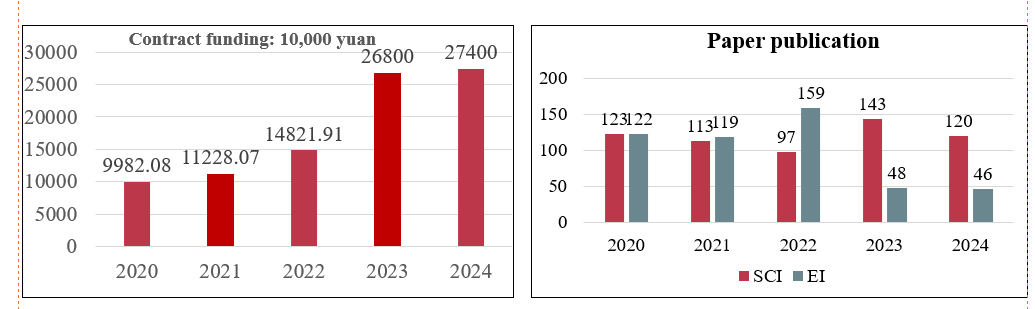
From January 1, 2021, to June 30, 2025, the school has achieved the following research outcomes:
Secured 1,008 new research projects with a total contract fund of 1.165 billion yuan.
Among these projects, 219 are vertical projects, including 2 NSFC Key Projects, 15 NSFC General Projects, 12 NSFC Young Scientists Fund Projects, and 54 National Key R&D Program Projects.
Won 16 provincial/ministerial or first-level society scientific research awards.
Published 481 SCI-indexed papers, 388 EI-indexed papers, and 4 ESI highly cited papers; added 27 monographs.
Obtained 306 authorized patents (including 273 invention patents) with a patent transformation value of over 340.9 million yuan.
The school has established cooperative relationships with many universities and well-known enterprises in countries such as the United States, the United Kingdom, Canada, Greece, Denmark, Japan, Belgium, the Czech Republic, and Australia. It has built an international joint laboratory — the Rockwell Automation Laboratory of Beijing Jiaotong University — and co-founded research cooperation institutions with overseas universities, such as the "Beijing Jiaotong University - University of New South Wales Wind Power Research Center". It has also established a strategic partnership with the IEEE Power & Energy Society (PES).A group of renowned foreign scholars have been invited to serve as part-time professors or honorary professors of the school to give lectures to students. Every year, the school selects outstanding undergraduates and postgraduates to study abroad for joint training with well-known foreign universities. It also takes the lead in undertaking the "111 Plan" Intelligence Introduction Base Project — the Innovation and Intelligence Introduction Base for Big Data Analysis and Processing of Active Distribution Networks.
Facing the national strategies and major industrial needs in the fields of rail transit and electric energy, the School of Electrical Engineering, under the correct leadership of BJTU and with the joint efforts of all faculty, staff, and students, adheres to the fundamental task of fostering virtue through education. It is committed to reform and innovation, continuously improving the quality of education and school-running standards, enhancing disciplinary strength, and striving to achieve the goal of building a "first-class School of Electrical Engineering with distinctive characteristics".
(Statistics are as of June 30, 2025)


